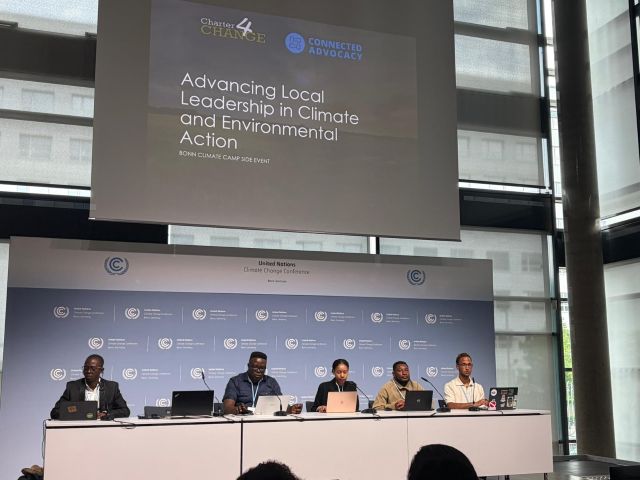
Global commitments, including the Grand
Bargain, the Paris Agreement, the Sustainable Development Goals
(SDGs), the Sendai Framework for Disaster Risk Reduction, and the
outcomes of international climate and humanitarian negotiations, have
increasingly recognized the importance of local leadership. However, implementation gaps persist. Across Africa:
Less
than a small proportion of international climate and humanitarian
financing reaches local organizations directly. Local
communities remain underrepresented in climate negotiations and policy
development. Energy
access initiatives are often designed without meaningful community
participation. Environmental
governance structures frequently exclude Indigenous Peoples, women, youth,
and frontline communities. Humanitarian
responses continue to be dominated by external actors despite commitments
to localization. The growing frequency of climate-induced
disasters, displacement, food insecurity, biodiversity loss, and energy poverty
requires a transition from externally driven interventions toward locally led
solutions that strengthen resilience and sustainable development.
Key Challenges
1. Limited Access to Direct Financing
Local organizations continue to face barriers
in accessing climate, humanitarian, and environmental funding due to:
Complex donor requirements. High compliance burdens. Limited institutional support. Preference for international intermediaries. This undermines the effectiveness,
sustainability, and ownership of development interventions. Policy Implication
Financing mechanisms must be redesigned to
ensure direct, flexible, and accessible funding for local actors.
2. Exclusion from Decision-Making Processes
Despite being first responders and frontline
implementers, local actors are often excluded from:
National climate planning. Humanitarian coordination structures. Environmental governance mechanisms. Energy transition policy processes. Policy Implication
Localization must move beyond consultation
toward shared decision-making and leadership.
3. Weak Integration of Climate, Humanitarian,
Environment, and Energy Agendas
Climate shocks increasingly drive humanitarian
crises while environmental degradation exacerbates vulnerabilities and limits
access to sustainable energy. However, responses remain fragmented. Policy Implication
Integrated and nexus-based approaches are
required to address interconnected challenges.
4. Energy Inequality and Energy Poverty
Over 600 million Africans still lack access to
reliable electricity, limiting opportunities for education, healthcare,
livelihoods, and climate resilience. Many energy projects fail to prioritize
community ownership and participation. Policy Implication
Energy transition efforts must support
decentralized renewable energy systems and community energy models.
5. Capacity and Institutional Barriers
Local organizations often lack access to:
Technical support. Organizational strengthening. Knowledge-sharing platforms. Policy engagement opportunities. Policy Implication
Long-term investments in institutional
strengthening are necessary to sustain localization efforts.
Policy Priorities for Africa
Priority 1: Local Leadership as the Foundation
of Development
Governments and development partners should
recognize local actors as equal partners rather than beneficiaries. Actions
Institutionalize
local representation in national decision-making bodies. Establish
localization targets within government programs. Promote
community-led planning and implementation.
Priority 2: Redirect Financing to Local Actors
Localization cannot succeed without equitable
access to resources. Actions
Increase
direct funding to local organizations. Simplify
grant application and reporting procedures. Establish
national and regional localization funds. Provide
multi-year flexible funding.
Priority 3: Strengthen
Climate-Humanitarian-Environment Nexus Programming
Integrated responses improve effectiveness and
resilience. Actions
Promote nexus programming frameworks. Support community resilience initiatives. Align
humanitarian responses with climate adaptation strategies. Encourage ecosystem-based approaches.
Priority 4: Advance Energy Democracy and Just
Energy Transition
Communities should be active participants and
beneficiaries of Africa's energy transition. Actions
Support
community-owned renewable energy projects. Expand
decentralized solar and mini-grid solutions. Integrate
local knowledge into energy planning. Prioritize
energy access for underserved communities.
Priority 5: Promote Inclusive Environmental
Governance
Environmental policies must be grounded in
local realities. Actions
Strengthen
community-based natural resource management. Protect
Indigenous and local knowledge systems. Increase
participation of women and youth in environmental governance. Support
locally led ecosystem restoration initiatives.
Recommendations
For African Governments
Adopt
national localization policies and implementation frameworks. Allocate
dedicated funding for local climate, humanitarian, and environmental
initiatives. Institutionalize
community participation in governance processes. Strengthen
enabling legal environments for civil society organizations. Integrate
localization into Nationally Determined Contributions (NDCs) and National
Adaptation Plans (NAPs).
For Donors and Development Partners
Increase
direct funding to local organizations. Provide
flexible, long-term financing. Simplify
compliance and reporting requirements. Invest in organizational strengthening. Support
locally led innovation and knowledge sharing.
For Regional Bodies and African Institutions
Develop
an African Localization Framework. Establish
regional learning and accountability mechanisms. Promote
South-South cooperation and peer learning. Advocate
for equitable access to climate and humanitarian finance.
For Civil Society and Local Actors
Strengthen
collective advocacy on localization. Document
and share evidence of locally led solutions. Build
partnerships across sectors and countries. Enhance
accountability and transparency mechanisms.
Expected Outcomes of the Africa Consultative
Dialogue
Connected Advocacy -The Global Localization
Forum is expected to produce:
1.
Benin Declaration on Localization
A collective African position on advancing
locally led climate, humanitarian, energy access, and environmental action. 2. Africa Localization Action Agenda
(2026–2030)
A roadmap outlining priorities, commitments,
and accountability mechanisms. 3. Localization Partnership Platform
A multi-stakeholder mechanism for collaboration
among governments, civil society, donors, academia, and private sector actors. 4. Policy Recommendations for
Global Processes
Contributions to:
UN Climate Processes. Humanitarian Reform Discussions. Sustainable Development Agenda implementation. Global Energy Access Initiatives.
Conclusion
Localization is no longer an option—it is a
necessity for achieving effective, equitable, and sustainable climate,
humanitarian, environmental, and energy outcomes across Africa. Frontline
communities possess the knowledge, leadership, and innovation needed to address
today's complex challenges. Connected Advocacy-The Global Localization Forum at
the World Social Forum in Benin Republic provides a timely opportunity to
amplify African voices, strengthen collective action, and advance a
transformative agenda that places local leadership at the center of
development, resilience, and justice. KeyMessage:
"Nothing for local actors without local actors. Local leadership must
be recognized, resourced, and respected as the foundation for climate
resilience, humanitarian effectiveness, environmental sustainability, and
energy democracy in Africa."
صور