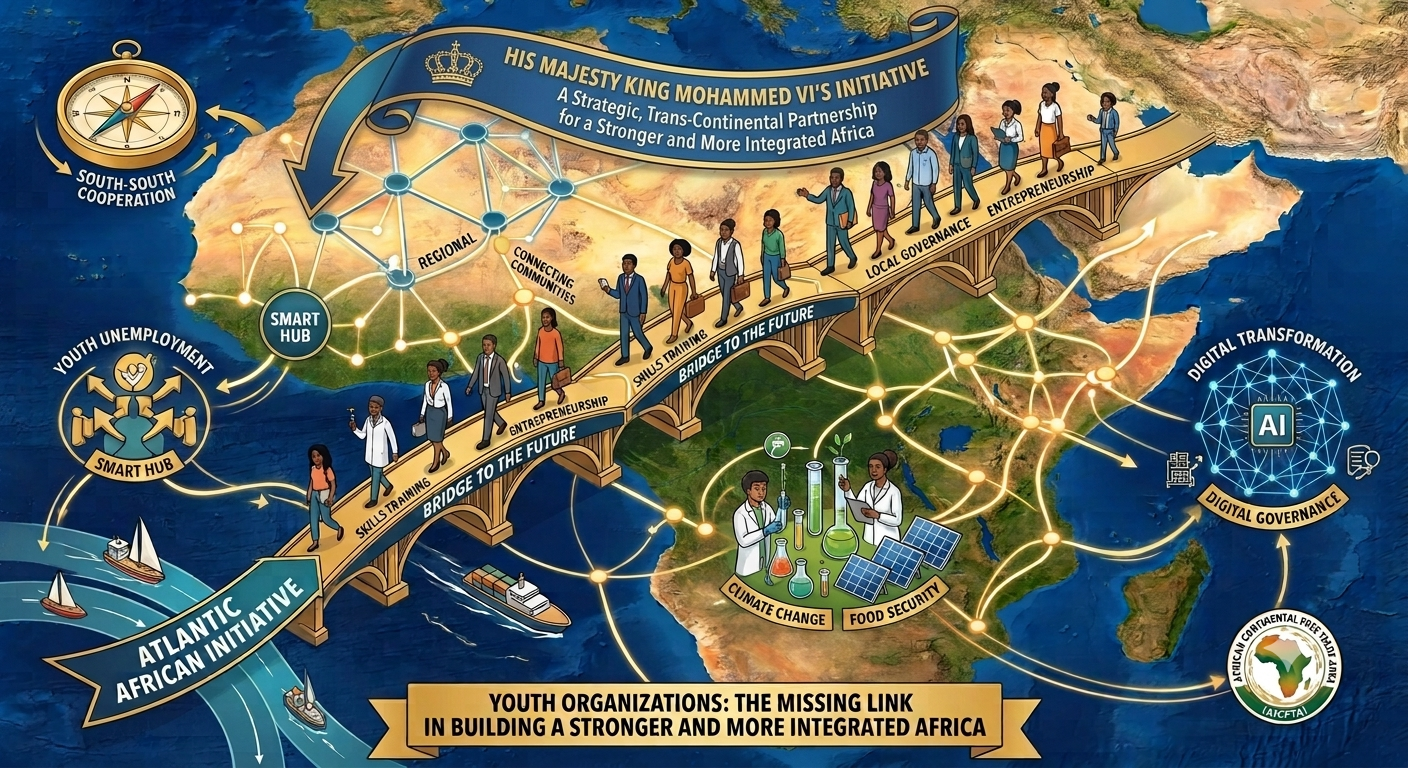
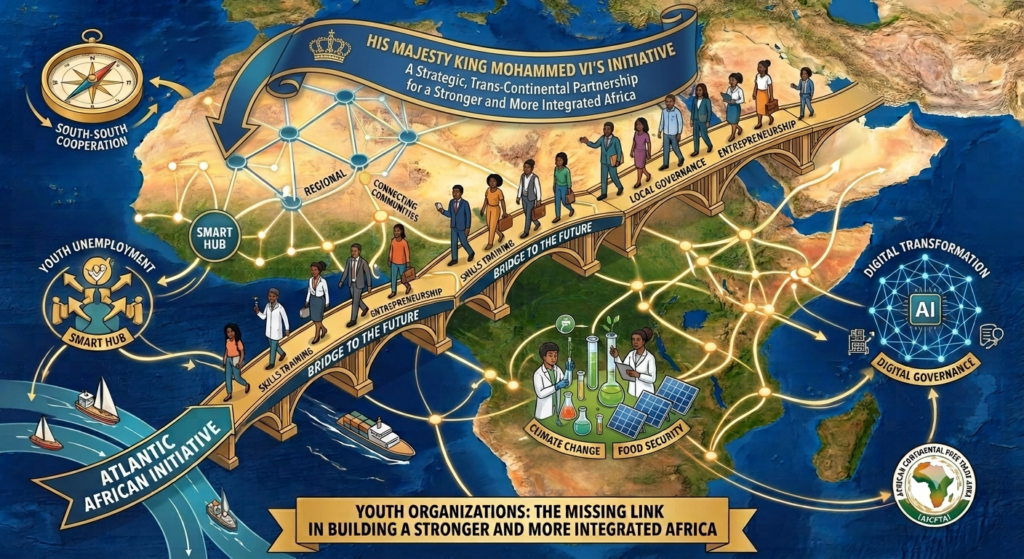
Youth Organizations: The Missing Link in Building a Stronger and More Integrated Africa
By Nidal Benali
President, Moroccan Local Youth Councils Network
Introduction : Africa is experiencing one of the most significant demographic transformations in modern history. With nearly 70% of its population under the age of 30, the continent possesses an extraordinary human capital capable of shaping its future. Yet this demographic advantage can only become a true development dividend if young people are empowered to participate meaningfully in political, economic and social life.
Too often, discussions about youth focus on unemployment, migration, insecurity or vulnerability. While these challenges are real, they should not define an entire generation. Across Africa, millions of young women and men are creating businesses, leading community initiatives, promoting peace, protecting the environment and developing innovative solutions to local challenges.
The real challenge facing Africa is therefore not a lack of talented youth. It is ensuring that young people have access to opportunities, decision-making spaces, financing and regional cooperation that allow them to transform their ideas into lasting impact.
Youth organizations stand at the heart of this transformation.
Youth Organizations: From Representation to Transformation
For decades, youth organizations have served as platforms for civic engagement and community participation. Today, however, their role extends far beyond representation.
They educate future leaders.
They promote democratic participation.
They strengthen local governance.
They encourage volunteerism.
They support entrepreneurship.
They build social cohesion.
They connect communities.
In many African countries, youth organizations have become trusted partners for municipalities, governments, universities, development agencies and international organizations because they possess something institutions alone cannot provide: proximity to local communities.
Their strength lies in understanding local realities while connecting young people to national, regional and international opportunities.
Africa Needs Partnerships More Than Promises
Many African countries continue to face similar challenges:
- Youth unemployment;
- Climate change;
- Food security;
- Urbanization;
- Migration;
- Digital transformation;
- Governance;
- Access to education;
- Economic inequality.
None of these challenges can be solved by one country acting alone.
They require stronger cooperation between African nations.
They require stronger institutions.
But above all, they require stronger partnerships between governments, local authorities, universities, civil society, businesses and youth organizations.
Africa's future will depend less on declarations and more on collective action.
South–South Cooperation: An African Solution for African Challenges
South–South cooperation has become one of the most promising frameworks for accelerating African development.
Rather than relying exclusively on external models, African countries increasingly exchange experiences, technologies, expertise and investment with one another.
This approach recognizes that countries facing similar realities often possess practical solutions that can be adapted across borders.
For youth organizations, South–South cooperation represents an extraordinary opportunity.
It enables young leaders to exchange best practices.
It facilitates joint projects.
It promotes intercultural dialogue.
It strengthens regional solidarity.
It creates networks capable of responding collectively to common challenges.
Youth organizations therefore become not only beneficiaries of cooperation but also active architects of African integration.
Morocco's Vision for African Cooperation
Over the past two decades, the Kingdom of Morocco has positioned cooperation with Africa as a strategic pillar of its foreign policy.
Under the leadership of His Majesty King Mohammed VI, Morocco has consistently promoted a model of partnership based on mutual respect, shared prosperity and South–South cooperation. Through investments, banking, infrastructure, agriculture, education, renewable energy and capacity-building, Morocco has sought to strengthen ties with African partners while encouraging sustainable and inclusive development.
One of the most significant recent initiatives is the Atlantic African Initiative, launched by His Majesty King Mohammed VI. The Initiative aims to transform the Atlantic African space into a strategic area of cooperation by promoting maritime connectivity, logistics, trade, investment and regional integration among Atlantic African States.
Beyond its economic dimension, this initiative opens new perspectives for universities, research centers, entrepreneurs, local authorities and youth organizations to develop common projects that strengthen African solidarity and create opportunities for future generations.
Its success will depend not only on governments but also on the active engagement of civil society and young Africans who will shape tomorrow's continental partnerships.
Business Cooperation Must Include Youth
Economic integration cannot rely solely on governments or multinational corporations.
Africa's future economy will increasingly be driven by:
- young entrepreneurs;
- start-ups;
- social enterprises;
- cooperatives;
- innovative SMEs.
Youth organizations can become catalysts for this transformation.
By connecting entrepreneurs, investors, universities, municipalities and development agencies, they create ecosystems that encourage innovation and generate employment.
Business forums, innovation hubs, cross-border incubators and youth entrepreneurship programmes should become essential components of South–South cooperation.
When young entrepreneurs collaborate across borders, they strengthen regional value chains and contribute directly to the objectives of the African Continental Free Trade Area (AfCFTA).
Economic cooperation therefore becomes a powerful instrument for peace, prosperity and regional integration.
Local Governance: Where Leadership Begins
Every continental transformation begins locally.
Young people who participate in municipal councils, local youth councils and community organizations acquire practical leadership skills while addressing real problems within their communities.
Local governance offers young people the opportunity to understand public policy, participate in decision-making and build trust between citizens and institutions.
Strengthening local youth councils across Africa therefore represents an investment not only in democracy but also in future continental leadership.
The experiences developed in one municipality can inspire hundreds of others across the continent.
Innovation and Digital Transformation
Africa's digital revolution offers unprecedented opportunities.
Young Africans are already leading innovation in fintech, agriculture, education, health, artificial intelligence and digital governance.
Youth organizations should embrace digital technologies not only as communication tools but also as instruments for civic participation, transparency, entrepreneurship and social innovation.
By connecting innovators across borders, African youth organizations can accelerate the continent's digital transformation while ensuring that technological progress remains inclusive.
From Consultation to Co-Decision
One of the greatest frustrations expressed by young people is that they are frequently consulted but rarely involved in final decisions.
Youth participation should not end once consultations are completed.
Young people must participate in:
- designing policies;
- implementing programmes;
- monitoring results;
- evaluating public action.
Moving from consultation to co-decision represents one of the most important democratic reforms Africa can undertake.
Youth organizations are uniquely positioned to facilitate this transition.
Conclusion
Africa possesses everything required to become one of the world's leading regions of innovation, entrepreneurship and sustainable development.
Its greatest resource is not its minerals.
Nor its geography.
Nor its natural wealth.
Its greatest resource is its youth.
But demographic potential alone is not enough.
Young Africans need opportunities.
They need institutions that trust them.
They need partnerships that cross borders.
They need access to financing, education, technology and decision-making.
Youth organizations provide the bridge between aspirations and action.
As Africa strengthens regional integration, expands South–South cooperation and develops ambitious initiatives such as the Atlantic African Initiative under the leadership of His Majesty King Mohammed VI, the contribution of youth organizations will become increasingly essential.
The future of Africa will not be built for young people.
It will be built with them.
As we often say within the Moroccan Local Youth Councils Network:
"We need to talk with young people, not about young people."
Only by placing youth at the centre of Africa's development agenda can we build a continent that is more united, more prosperous and better prepared for the challenges and opportunities of the twenty-first century.
Photos